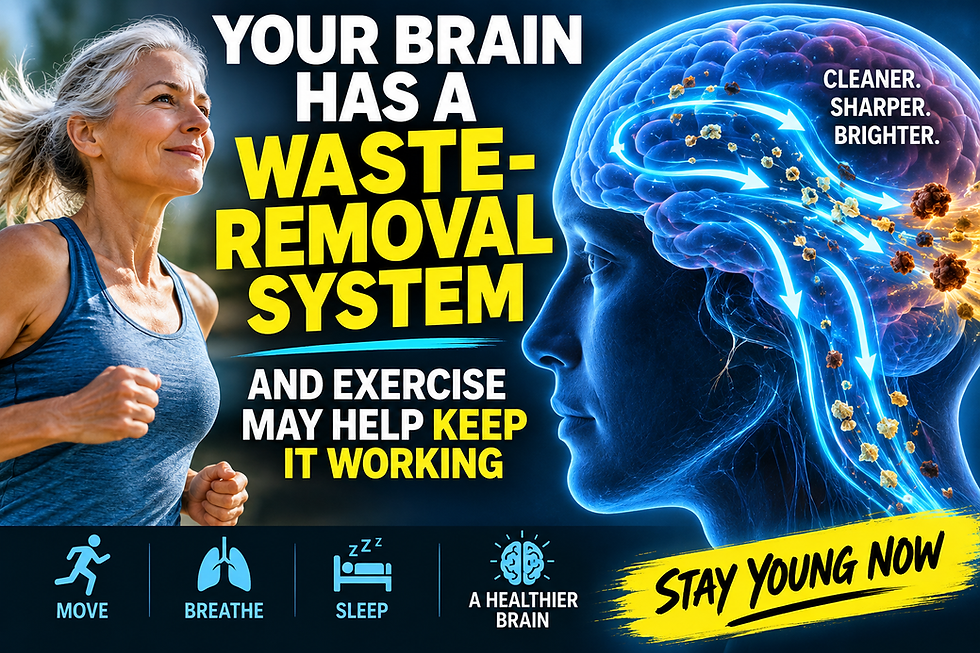
Mental Health and Movement: The Underrated Link

When most people think about exercise, they think about the body: stronger muscles, a healthier heart, better mobility, weight management, and improved physical performance.
But that is only half the story.
Movement also has a powerful relationship with the brain and mental health. Regular physical activity can influence mood, stress, sleep, cognitive function, confidence, and even the way we connect with other people.
And as we get older, these benefits may become even more important.
Exercise Isn't Just Physical
The connection between exercise and mental health isn't a new idea. What may be underestimated is just how broad that connection appears to be.
Research has consistently associated regular physical activity with improvements in symptoms of depression and anxiety. And importantly, these benefits aren't limited to traditional cardiovascular exercise.
Strength training matters too.
Research involving older adults has found that resistance training can improve symptoms of depression and anxiety as well as broader measures of mental health and quality of life.
That means lifting weights isn't simply about preserving muscle.
It may also be helping preserve something equally important: how you feel.
Why Movement Matters Even More After 50
Life changes as we get older.
Retirement, changes in family structure, children moving away, reduced social interaction, injury, illness, and the loss of friends or loved ones can all affect our sense of connection and purpose.
At the same time, physical activity often begins to decrease. That combination can become a problem.
Movement provides something that goes beyond burning calories. It gives the body and brain a reason to stay engaged.
A walk creates movement.
A strength workout creates challenge.
A group fitness class creates social interaction.
Learning a new exercise creates mental stimulation. And becoming physically stronger creates something many people don't think about when discussing exercise:
confidence.
When someone who once struggled to stand from a chair becomes stronger, that's more than a physical adaptation. When someone begins walking farther without getting tired, that's more than just cardiovascular fitness. When someone discovers that they can lift, move, balance, react, and perform tasks they thought they had lost, they begin rebuilding a sense of capability.
And that feeling can carry into the rest of life.
Movement Is Also Brain Training
Exercise creates a series of responses throughout the nervous system and brain.
Physical activity is associated with changes in neurotransmitter activity and with brain-derived neurotrophic factor, or (BDNF), a protein involved in neural health, plasticity, learning, and memory.
Exercise also interacts with the body's stress-response systems and can help improve sleep.
These systems don't operate independently.
Better sleep can improve mood.
Improved mood can make us more willing to be active.
Greater physical capability can increase confidence.
And increased confidence may make us more willing to participate in life.
Movement can create momentum.
Strength Training Deserves More Attention
For years, cardiovascular exercise dominated conversations about exercise and health.
Walk more. Run. Bike. Swim.
All of those are valuable. But strength training deserves a seat at the same table. Research in older adults has found meaningful mental-health benefits from resistance training, including improvements in depressive and anxiety symptoms. Strength also has another psychological advantage: progress is visible.
You lift a weight today that you couldn't lift several months ago.
You perform ten repetitions with a weight that once felt heavy for five.
You stand up more easily.
You climb stairs with greater confidence.
You carry your groceries without struggling.
Those experiences provide immediate evidence that your body is adapting. That creates a powerful message:
I am still capable of improving.
Exercise and the Aging Brain
Movement may also play an important role in maintaining cognitive function as we age.
Research examining adults over 50 has found that physical exercise can improve cognitive performance, with benefits seen from aerobic exercise, resistance training, multicomponent exercise, and practices such as tai chi.
This doesn't mean exercise makes someone immune to cognitive decline.
It means physical activity is one of the modifiable behaviors we can use to support brain health throughout life.
And that gives us another reason to keep moving as we age.
The Social Side of Exercise
There is another part of exercise that doesn't get enough attention:
people.
Walking groups, fitness classes, recreational sports, pickleball, strength-training groups, dance classes, and other activities combine movement with human connection.
You aren't simply exercising.
You're talking.
Laughing.
Learning.
Competing.
Encouraging someone.
Being encouraged.
And showing up somewhere where other people expect to see you. For someone experiencing loneliness or isolation, that social component can be extremely valuable. Sometimes the workout is only part of the medicine.
Connection is the other part.
How Much Movement Do You Actually Need?
You don't have to become an athlete to receive the benefits of exercise. Current physical-activity guidelines recommend approximately 150–300 minutes of moderate-intensity aerobic activity per week, along with muscle-strengthening exercise involving the major muscle groups on at least two days per week.
But those numbers shouldn't discourage someone who is currently doing very little.
The most important principle is much simpler:
Start moving.
Walk for ten minutes.
Lift weights twice a week.
Join a class.
Play pickleball.
Ride a bike.
Work in the garden.
Go hiking.
Practice balance.
Learn something physical you've never done before. Then gradually build from there.
Consistency matters far more than trying to destroy yourself with one exhausting workout.
Movement Gives Us Something We Need: Capability
Perhaps one of the most overlooked benefits of exercise is that it reminds us of what we can still do. Aging can gradually convince people to become cautious.
Don't run.
Don't jump.
Don't lift something heavy.
Don't move too quickly.
Don't try something new.
Eventually, the world of movement becomes smaller.
But appropriately designed exercise can begin expanding that world again.
Strength can be rebuilt.
Balance can improve.
Movement can become faster.
Endurance can return.
Confidence can grow.
And the brain continues receiving the message that the body is still expected to adapt.
The Bottom Line
Exercise should never be viewed only as something we do to change our bodies. Movement is also an investment in the brain, mood, confidence, sleep, independence, social connection, and quality of life. It won't solve every mental-health challenge, and it isn't a substitute for professional mental-health care when that care is needed.
But movement belongs in the conversation.
Especially as we get older.
Because staying physically active isn't simply about adding years to life.
It's about protecting our ability to think, move, connect, participate, and feel capable during the years we have.
Keep moving. Keep challenging yourself. Keep giving your body — and your brain — a reason to adapt.
Don't forget to learn more about how to be young; check out my book "Stay Young Now" on Amazon.com
Jason Kelly